
How to File VAT Returns in UAE: Step-by-Step Guide 2026
VAT isn’t something you want hanging over your head, but ignoring it isn’t an option in the UAE anymore. The moment your business crosses the registration threshold, you’re on the hook not just for submitting returns, but for doing it accurately and on time. The Federal Tax Authority (FTA) gives you just 28 days after each tax period ends to both file your VAT return and settle any payment due. Missing that window means penalties are waiting for you.
So, today, let’s talk about how to file VAT returns in the UAE that you can actually follow and act on with confidence.
What Is VAT in the UAE?
In the UAE, VAT or Value Added Tax is the tax added to most goods and services you buy. It’s like a tiny percentage that the government collects to support public services.
When Did VAT Start in the UAE?
- VAT officially began on January 1, 2018.
Before that, the UAE didn’t have any form of tax on everyday purchases, so this was a big change for the country.
Why Was VAT Introduced?
The UAE introduced VAT to:
- Reduce dependence on oil revenue.
- Support long-term national development.
- Ensure a more stable economy.
- Fund essential public services.
How Much Is the VAT?
The standard VAT rate is 5%.
Some things are either zero-rated (0%) or exempt, such as:
- Basic healthcare.
- Some educational services.
- International transport.
Who Can File for VAT in the UAE?
VAT registration is mandatory if your business’s taxable supplies & imports are AED 375,000 or more per year.
Documents You Need for Filing a VAT Return in the UAE
These documents are your “proof” of anything you report in the VAT 201 form.
Here are the documents required for VAT return UAE:
- 1. Sales Invoices
- 2. Purchase Invoices
- 3. Credit Notes & Debit Notes
- 4. Import Documents
- 5. Purchase/Expense Summary Reports
- 6. Trade Licence
- 7. Tax Registration Certificate
What You’re Actually Reporting
VAT return in the UAE 2026 is a declaration of:
- Output VAT: The 5% VAT you collected from your customers
- Input VAT: The VAT you paid on eligible business purchases
- Net VAT due or refund: What you owe the FTA or can recover
- Every VAT-registered business has to provide these figures for each tax period.
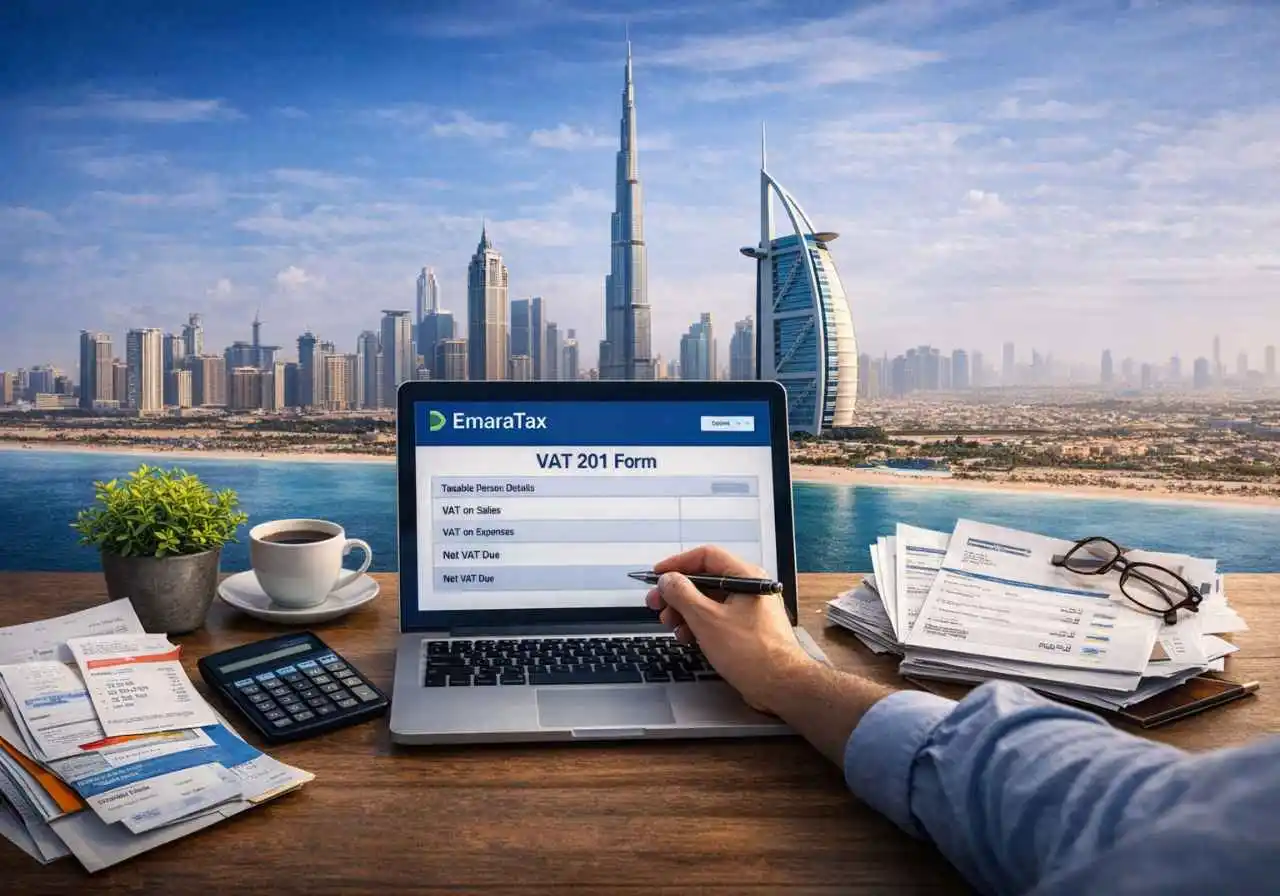
Your VAT return goes on Form VAT 201 through the FTA’s EmaraTax online portal. The EmaraTax portal is the official gateway for submitting and paying your VAT.
VAT return form 201 explained
The actual return form you file is called VAT 201 form in UAE. It has multiple parts:
- Taxable Person Details
- Tax Period
- VAT on Sales
- VAT on Expenses
- Net VAT Due: It’s the difference between outputs and inputs (you either pay this or claim a refund if input is higher).
- Other Adjustments: It includes reverse charges, exemptions, and special codes depending on what your business does.
- Declaration: where you sign off that everything is true to your knowledge.
How to File VAT Return in UAE
So, let’s have a look at the UAE VAT return filing process.
1. Gather Your Records First
- Sales invoices (with VAT amount clearly visible)
- Purchase invoices (with recoverable VAT)
- Any imports/exports or reverse charge cases
- Bank statements (to reconcile totals)
Having these in order saves time and keeps you from backtracking.
2. Log Into EmaraTax
- Head to the portal and authenticate.
- Navigate to VAT - My Filings - File Return.
3. Confirm Your Tax Period
During the UAE VAT filing process, you need to make sure that the filing period is correct. It may sound simple, but people mess this up when they rush.
4. Fill in Sales and Purchase
Write the total VAT you charged customers in the output Vat section.
Match and input the total VAT you’re claiming back on purchases in the section Input VAT.
5. Review the Numbers
- Cross-check totals against your accounting system or spreadsheet.
- Let the form compute it after you’ve put all the correct values.
6. Declare & Submit
- Once you’ve looked at it and it's correct, then submit it.
- You’ll get a confirmation reference. Save that. You’ll need it in case of audits later.
This step-by-step guide to VAT return filing in the UAE will help you to always stay compliant with the FTA.
How VAT Return Periods Work in 2026
Your filing frequency is assigned by the FTA. It’s usually:
- Quarterly for most businesses
- Monthly for high turnover companies
Whatever your period is, the rule remains the same. Your VAT return and payment must reach the FTA within 28 days from the end of that tax period. This is the VAT return deadline in the UAE.
Why This Matters
Mistakes or delays in VAT often lead to late penalties, extra fines, and even audits.
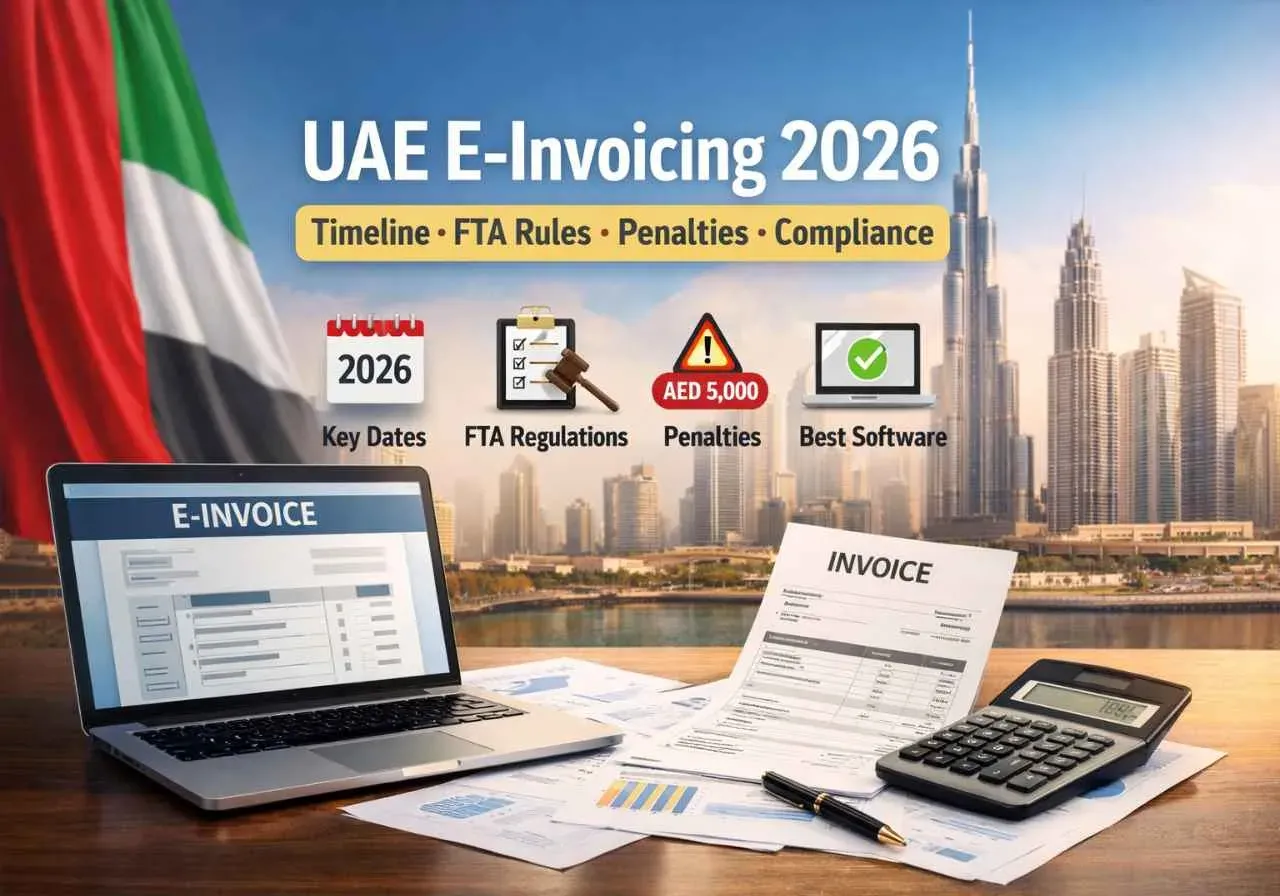
Besides, with the UAE introducing e-invoicing standards in phases from mid-2026, you’re going to see a big change in how VAT data flows between buyers, sellers, and the FTA. So future VAT filing may become even more dynamic.
VAT Return Checklist
- Verify sales & purchases totals.
- Check VAT amounts on invoices.
- Connect with bank statements.
- Confirm reverse-charge entries.
- Ensure correct tax period.
- Apply adjustments.
- Review & submit.
Penalties for Late VAT Filing in the UAE
| Type of Violation | Penalty Amount |
|---|---|
| Late submission of the VAT return | AED 1,000 for the first time |
| Repeated late submission (within 24 months) | AED 2,000 |
| Late payment of due VAT | 2% of the unpaid tax (one-time) |
| Late payment after seven days | 4% of the unpaid tax (one-time) |
| Daily penalty for continued non-payment (from day 31 onward) | 1% per day, up to 300% maximum |
| Incorrect VAT return leading to tax understatement | Minimum AED 1,000, plus percentage-based penalties depending on the error |
| Failure to keep proper VAT records | AED 10,000 (first time), AED 50,000 (repeat) |
Common VAT Filing Mistakes in UAE
- Missing mandatory fields on tax invoices.
- Wrong treatment of zero-rated or exempt supplies.
- Forgetting reverse charge transactions.
- Claiming input VAT on non-eligible expenses.
- Not recording credit/debit notes.
- Mismatch between accounting records and bank statements.
- Incorrect tax period selection.
VAT Calculation
Let’s have a look at how to calculate VAT to maintain the UAE VAT compliance.
Let’s imagine your product’s net price is 100 AED.
Now the formula works like this:
Net Price × VAT Rate/100 = The amount of VAT
100 × 5/100 = 5 AED
So, to get the total price with VAT, we need to add the net price to the VAT amount.
100 + 5 = 105 AED
How Accounting Software Helps with VAT Compliance
Honestly, keeping VAT-related data clean manually feels like struggling while hoping a single misplaced invoice doesn’t throw off your entire VAT 201 form in the UAE. This is where accounting software quietly helps you.
- It maps sales and purchase entries automatically to the right VAT codes.
- It keeps your input and output VAT totals lined up with the structure on the Federal Tax Authority portal.
- It reminds you of filing deadlines.
- It stores all invoices in one place, so you don’t need to hunt through email chains when you're trying to reconcile.
How to calculate VAT in UAE - Free Online VAT Calculator
How to Choose the Best Accounting Software in the UAE?
Here are a few things that genuinely matter in the UAE market context:
- VAT Handling Has to Be UAE-Specific: Choose the accounting software in the UAE that clearly supports UAE VAT codes, FTA-approved formats, or aligns with EmaraTax data structures.
- Local Support Matters More Than You Think: You need support teams who understand local filing cycles, industry quirks, and upcoming regulatory changes.
- Multi-currency & GCC-Friendly: Dealing with multiple currencies like USD, SAR, INR, EUR, and AED is common in the UAE. You need a flexible system that saves you from exchange-rate nightmares.
Filing VAT returns certainly isn’t unpredictable. But it does require discipline and the right system backing you. Get the process right, following the step-by-step guide to VAT return filing in the UAE, and you remove one of the biggest compliance headaches businesses face today.
With the 2026 changes and upcoming e-invoices, there’s even more reason to keep your compliance engine running smoothly by knowing how to file VAT return in UAE, because the rules aren’t going to get looser, and they aren’t going away.
Read this blog also
UAE Corporate Tax Compliance Checklist for SMEs (2026)
FAQ
1. How do I know if I’m supposed to file VAT returns in the UAE?
If your business is registered for VAT in the United Arab Emirates, then filing returns becomes part of your routine.
2. What if I make a mistake while entering my VAT numbers?
Mistakes happen, and it’s common. If you notice it quickly, you can correct the issue by submitting a voluntary disclosure through the Federal Tax Authority.
3. Why do some businesses file monthly while others file quarterly?
That schedule is set by the FTA. Most companies file quarterly, but businesses with larger activity often get assigned a monthly filing.
4. Can I stick to spreadsheets for VAT, or is software necessary?
You can manage with spreadsheets, but it becomes harder as your transactions grow. At the same time, software keeps things cleaner; you don’t need to scramble at the end of every period.
5. Will the new e-invoicing rules in 2026 make filing VAT more complicated?
They’re expected to make things more organized, not harder. Once e-invoicing rolls out in phases, your transaction data will align more smoothly with the FTA’s system.
 Our More Blogs