
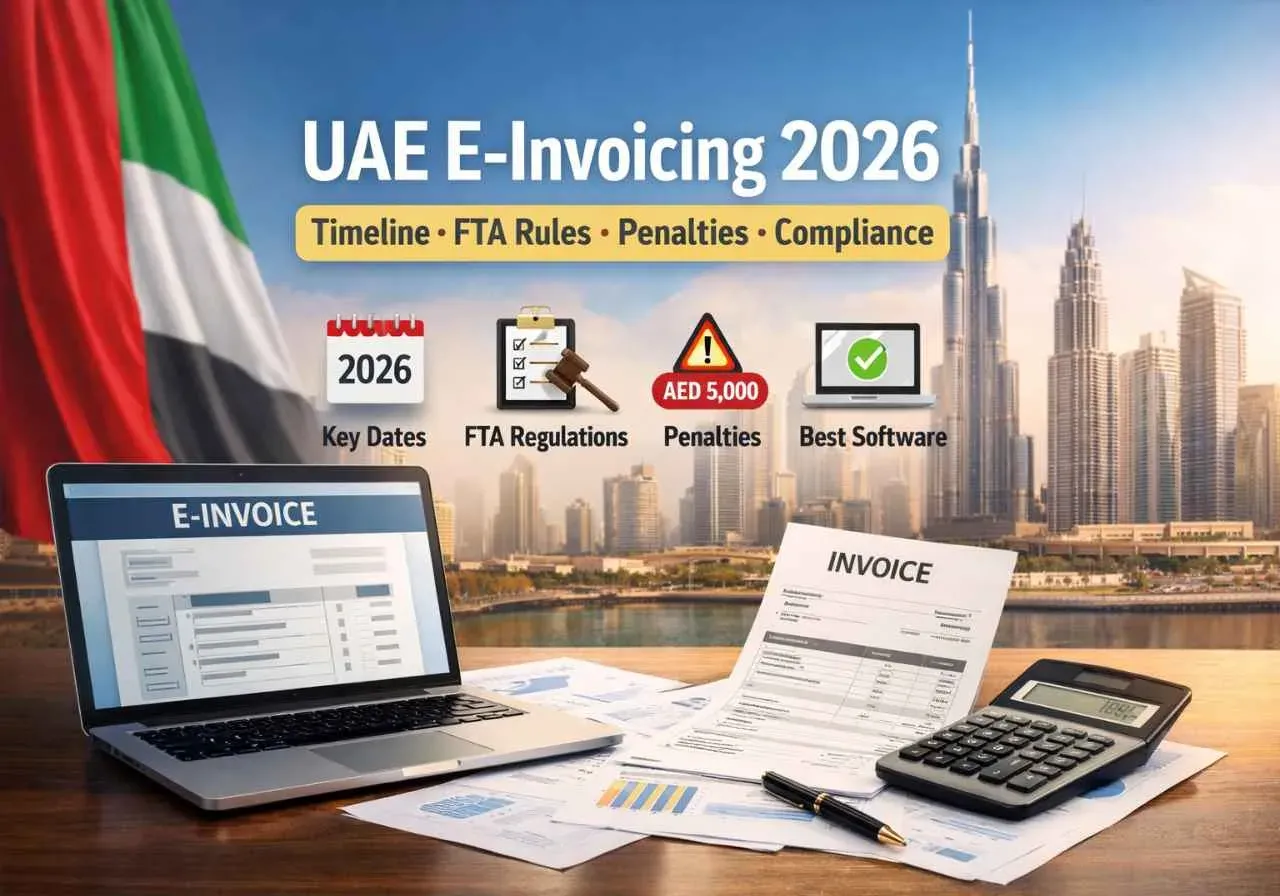
UAE E-Invoicing 2026: Timeline, FTA Rules, Penalties & Software Guide
The UAE is tightening the way businesses handle tax, records, and reporting, and that is exactly why UAE e-invoicing 2026 is getting so much attention now.
It is now defined, published, and scheduled. For finance teams in Dubai, Abu Dhabi, and across the UAE, that changes the entire conversation. Now there’s no guessing what the Federal Tax Authority or Ministry of Finance might do next. It is about following the rollout properly, fixing old invoicing habits, and making sure the system behind your invoices can survive the scrutiny.
There is also one detail that many businesses are still getting wrong. Many people are still thinking e-invoicing will become fully mandatory in 2026. Well, this assumption is partially right. The pilot phase will start on 1 July 2026, along with the voluntary adoption. Mandatory implementation will then begin in phases, starting on January 1, 2027, depending on revenue and entity type. That distinction affects budgets, software decisions, onboarding deadlines, and how much time a business really has to prepare.
Today, we’ll break down what UAE e-invoicing 2026 actually means, what is in scope, what businesses need to change, and how to choose UAE e-invoice software without getting trapped in a flashy demo and a weak backend.
What is e-invoicing in the UAE?
E-invoicing in the UAE is the process of generating, sending, and storing invoices in a structured digital format that fits the country’s evolving compliance framework.
That sounds simple, but the difference matters. A lot of businesses still think a PDF invoice sent over email counts as digital invoicing. Technically, it is digital in the everyday sense. In compliance terms, that is not the same thing. A proper e-invoice is built so systems can read it, validate it, and process it without depending on someone to open a file and manually interpret what is inside.
Unlike traditional invoices, e-invoices are:
● Machine-readable
● Automatically validated
● Integrated with accounting systems
Basically, E-invoicing in Dubai and the UAE is a digital system that allows businesses to create and exchange invoices electronically in a standardized format, so invoice data is easier to process, verify, and use for VAT compliance.
Is e-invoicing mandatory in the UAE?
Yes, e-invoicing is mandatory in the UAE. FTA e-invoicing in the UAE is being introduced as part of the country’s broader digital tax direction, and businesses should already be preparing for it seriously.
2026 is the year businesses need to get ready, test systems, and stop delaying decisions. It is the point where preparation turns into action.
The reason behind the push is fairly clear:
● Improve VAT compliance
● Reduce tax fraud
● Enable instant invoice reporting
For businesses in Dubai, Abu Dhabi, and across the UAE, the important question is if the business is still relying on invoicing methods that were good enough for the last few years but are not strong enough for what comes next. Many companies only react once the deadline feels close. That is usually the worst time to start. By then, software decisions get rushed, finance teams are under pressure, and small data problems suddenly become major operational problems.
UAE E-Invoicing Phases Explained (2026–2027 Rollout)
Besides the dates, the UAE is moving through e-invoicing in phases, which makes sense because no one wants to drop a change like this into the middle of thousands of businesses all at once.
Phase 1: Preparation (Current Stage)
Awareness and planning & system upgrades
This is the stage many businesses are in right now. Some are actively planning. Others are just watching from a distance and hoping the transition will be simpler than it probably will be. Preparation usually means reviewing current invoicing workflows, checking if the existing accounting or ERP system can support structured invoicing, and figuring out where the weak spots are before they become urgent.
Phase 2: Integration
Adoption of compliant Accounting software in the UAE & system testing and validation
This is the stage where a business has to decide what software it will use, how invoice data will move, how VAT will be calculated inside the system, how records will be stored, and if the setup can actually handle compliance without human patchwork every few steps. Testing matters here more than you even expect, because a workflow that looks fine in a meeting can fall apart the moment real invoice data hits it.
Phase 3: Mandatory Compliance (2026)
E-invoicing becomes compulsory & real-time or near real-time reporting is enforced.
For many businesses, UAE e-invoicing 2026 is about the fact that the window for casual delay is closing. That is the best way to consider it. Once the compliance environment becomes more structured, businesses will need working systems.
UAE E-Invoicing Timeline and Rollout
Therefore the phrase "UAE e-invoicing 2026" is important, primarily because it indicates the year by which businesses need to prepare, test, select an ASP, and stop assuming there is endless time left.
1 July 2026
The pilot program starts for selected participants who agree to join. Voluntary implementation is also open to any person who wants to adopt early.
31 July 2026
Businesses with annual revenue of AED 50 million or more must appoint an Accredited Service Provider by this date.
1 January 2027
Mandatory implementation starts for businesses with an annual revenue of AED 50 million or more.
31 March 2027
Businesses with annual revenue below AED 50 million and government entities must appoint an ASP by this date.
1 July 2027
Mandatory implementation starts for businesses with annual revenue below AED 50 million.
1 October 2027
Mandatory implementation starts for government entities.
What transactions are in scope?
The UAE framework broadly covers B2B, B2G, G2B, and G2G transactions.
Business-to-consumer transactions are not currently subject to the Electronic Invoicing System, and a person engaged exclusively in B2C transactions is not yet subject to the system until a later ministerial decision says otherwise.
There are also exclusions for certain sovereign activities, certain airline passengers and related documents, a temporary exclusion for some airline goods transportation documents, and exempt financial services under the VAT Executive Regulation.
UAE E-Invoicing Requirements
The compliance side has two layers: business data and technical process.
The UAE has already provided mandatory field requirements. These include invoice identifiers, invoice dates, seller and buyer details, legal registration information, tax identifiers where relevant, totals, tax breakdowns, and invoice line information. Additionally, fields such as electronic address, registration identifiers, city, country code, tax amount, tax category, and amount due are part of the framework.
On the technical side, the UAE framework uses the Peppol interoperability structure and PINT-AE specifications. That means invoice data moves through an accredited network, must be converted into the UAE standard XML format, and must be reported to the FTA through the ASP flow.
Another practical detail matters here. Your e-invoicing participant identity is tied to your TIN. For entities already registered with the FTA, the TIN is the first 10 digits of the TRN.
E-Invoicing for Businesses in Dubai & UAE
E-invoicing is not only for large corporations or finance-heavy businesses. Its value shows up across different industries but in different ways.
SMEs in UAE
For smaller businesses, e-invoicing can make VAT compliance in the UAE less fragile. Many SMEs depend on a few people handling too many tasks at once. Invoicing, payment follow-up, VAT review, reconciliation, and records all blur together. A more structured invoicing process will reduce manual mistakes and give the business a better chance to stay accurate without constant double-checking.
Service-Based Companies in Abu Dhabi and Other Places (B2B)
Service companies usually have their own invoicing complexity, like recurring invoices, milestone billing, mixed tax treatments, contract-based schedules, and client-specific formats, and it adds up. E-invoicing can help them organize that process and make financial reporting less dependent on manual intervention.
Benefits of E-Invoicing for UAE Businesses
1. Improved VAT Compliance
E-invoicing helps businesses create invoices with the right details in a more consistent way. That reduces the chance of VAT mistakes caused by missing information, wrong tax amounts, or badly handled classifications. Compliance is rarely damaged by one giant mistake. It is usually damaged by a collection of smaller errors.
2. Faster Payments
Digital invoices usually move faster through the business cycle. They are easier to issue, easier to track, and less likely to get delayed because of incomplete details or format confusion.
3. Reduced Errors
Manual invoicing creates room for repetition, typo-level mistakes, duplicate entries, wrong totals, and mismatched records between departments. Automation reduces that. It eliminates routine mistakes that waste time and create unnecessary corrections.
4. Audit Readiness
A proper e-invoicing setup keeps records in a more organized, structured way. That matters during reviews, internal checks, and FTA audits. Businesses that still rely on scattered files and manual matching often discover too late how much energy is spent just proving that an invoice exists in the right form.
5. Increased Efficiency
E-invoicing can reduce repetitive work across finance and operations. This means there’ll be less manual re-entry and less struggle over invoice corrections.
Businesses using automated invoicing systems often see better accuracy, smoother reporting, and less wasted time inside finance workflows. That alone can make the shift worthwhile, even before the compliance side becomes mandatory.
Penalties for Non-Compliance With UAE E-Invoicing
Failing to adopt e-invoicing can lead to:
● Compliance penalties
● VAT miscalculations
● Delayed reporting
● Increased operational costs
Cabinet Decision No. 106 of 2025 has set out electronic invoicing penalties.
● Failing to implement the system or to appoint an approved service provider within the required timeline carries a penalty of AED 5,000 for each month.
● Failing to issue and transmit an electronic invoice on time carries a penalty of AED 100 per invoice, capped at AED 5,000 per calendar month.
● Similar penalties apply to electronic credit notes, and there are daily delay penalties for failing to notify the FTA of system failures or to notify the approved service provider about required data changes within the prescribed timeframe.
Voluntary users are exempt from these e-invoicing penalties until they become mandatorily subject to the system.
Overall, the harder cost is not the fine, though. It is the disruption, rushed ERP changes, bad master data, finance teams manually fixing failed transmissions, and buyers not receiving data correctly.
Common Mistakes Businesses Will Make
A few mistakes are already predictable.
● One is assuming a PDF invoice generated by accounting software counts as UAE digital invoicing. It does not apply unless it is part of the structured exchange and reporting framework.
● Another challenge is choosing software before understanding the ASP model. In the UAE framework, businesses can’t just simply “buy e-invoicing software” and finish the job. They need onboarding with an Accredited Service Provider and system readiness for data exchange, confirmation messages, and reporting flow.
● A third is ignoring master data. Missing registration details, inconsistent customer records, wrong tax identifiers, and messy legal entity information will become real problems in a structured model.
UAE E-invoicing implementation steps
Step 1: Assess Your Current System
Check if your current ERP or accounting software in the UAE can extract the mandatory invoice fields, support structured data exchange, and integrate cleanly with an ASP. Businesses need to identify these points and confirm their systems can extract them.
Step 2: Choose UAE-Compliant Software
Pick a solution that fulfills the requirements of FTA e-invoicing in the UAE and is reliable for the business size, industry, and workflow. The right software should support invoicing, VAT logic, reporting accuracy, and practical day-to-day use. Compliance matters, but usability matters too.
Step 3: Automate VAT Processes
Make sure to match the VAT invoice format for the UAE. Furthermore, ensure VAT calculations and related invoice logic are automated wherever possible. The more a business depends on people remembering tax details manually, the more fragile the process will become. At the same time, effective systems reduce dependence on memory and routine corrections.
Step 4: Train Your Team
Even a strong system can fail if the people using it do not understand the new workflow. Finance teams need to know what changes. Operations teams need to know what affects billing. Whoever touches invoice data needs to know where mistakes can begin.
Step 5: Test Before Going Live
Run test invoices before full implementation. Verify accuracy, formats, totals, and reporting outputs. Also, keep an eye on what happens when something goes wrong. It is much better to discover weaknesses during testing than during a live compliance cycle when everything is already moving.
How to Choose FTA-Compliant E-Invoicing Software in UAE
A reliable system for UAE e-invoicing 2026 should do more than generate invoices.
● So, look for strong VAT handling, mandatory field support, structured invoice generation, cloud access where appropriate, clean ERP integration, audit-friendly search and storage, and effortless coordination with an accredited service provider.
● Also, look at support quality. When invoice exchange fails, you do not need a chatbot and a ticket number. You need someone who can explain what broke and how to fix it.
● It also helps to work with a UAE-focused provider or implementation partner that understands local compliance, VAT structure, entity setups, and how businesses here actually operate.
UAE E-Invoicing vs Traditional Invoicing (Comparison)
| Features | Traditional invoicing | UAE e-invoicing |
| Format | PDF, paper, email attachment. | Structured digital data. |
| Processing | Mostly manual. | Automated exchange and reporting. |
| VAT compliance | Higher risk of human error. | Built for rule-based reporting. |
| Speed | Slower approvals and reconciliation. | Faster transmission and validation. |
| Audit readiness | Often document-heavy and scattered. | Easier search, traceability, and reporting. |
FAQs: e-invoicing in the UAE
1. What is the UAE e-invoicing system?
The UAE e-invoicing system is a framework where invoices are created and exchanged in a structured electronic format, not handled as paper files or basic PDFs. The idea behind UAE e-invoicing 2026 is to make invoicing cleaner, faster, and easier to manage for businesses that need better tax and VAT compliance in the UAE.
2. Is e-invoicing mandatory in the UAE?
Yes. The UAE has made e-invoicing mandatory for in-scope individuals, but implementation is phased. So, businesses in the UAE should prepare for e-invoicing as part of the country’s digital tax compliance direction, with 2026 being a major preparation point.
3. When does UAE e-invoicing start?
The first stage of UAE e-invoicing 2026 will begin on July 1, 2026, with a pilot and a voluntary rollout. It does not become mandatory for every business on the same day, because the UAE is introducing it in phases.
4. Is a PDF invoice an e-invoice in the UAE?
No, a PDF invoice is not treated as a proper e-invoice under UAE e-invoicing rules. The Ministry of Finance has made it clear that PDFs, Word documents, scans, images, and invoices shared by email are still unstructured formats, so they do not meet the actual UAE e-invoicing requirements.
5. Do SMEs in the UAE need to comply?
Yes, SMEs will also need to follow the rules in case they fall within the scope. The current rollout plan says businesses with revenue below AED 50 million are expected to come under mandatory FTA e-invoicing UAE implementation from 1 July 2027.
6. Are B2C invoices included?
Not for now. Business-to-consumer transactions are currently outside the system unless a later decision brings them in.
7. How do businesses connect to the system?
Businesses need to connect through an accredited service provider, with onboarding initiated via EmaraTax.
8. What software supports UAE e-invoicing?
FTA-compliant accounting or ERP software that supports structured invoicing, VAT handling, automation, and reporting is the right type of solution for UAE e-invoicing.
9. What are the penalties for non-compliance?
They include an AED 5,000 per month for delay in implementation or ASP appointment, plus transaction-based penalties for late electronic invoices and credit notes.
10. How does e-invoicing help with VAT?
It improves VAT handling by reducing manual errors, creating more accurate invoices, and supporting better reporting consistency.
Conclusion
The move toward UAE e-invoicing 2026 is not just another compliance update that businesses can skim and ignore for a few more quarters. It marks a real shift in how invoicing, VAT accuracy, and financial records will be handled in the UAE. Businesses that start early usually get something valuable out of it beyond compliance. They get cleaner systems, fewer mistakes, and less daily friction inside finance operations.
Delaying the shift usually creates the opposite result, with more pressure, more corrections, more rushed decisions, and more dependence on manual work at the exact moment it becomes more risky.
Need UAE-compliant e-invoicing software?
Prepare your business with a strong UAE e-invoice software solution that supports:
● Full FTA compliance
● Automated VAT calculations
● Instant reporting
● Secure cloud access
Start with the software, process review, and internal planning now, so your business can stay ready before compliance pressure starts forcing undesirable decisions.
 Our More Blogs