

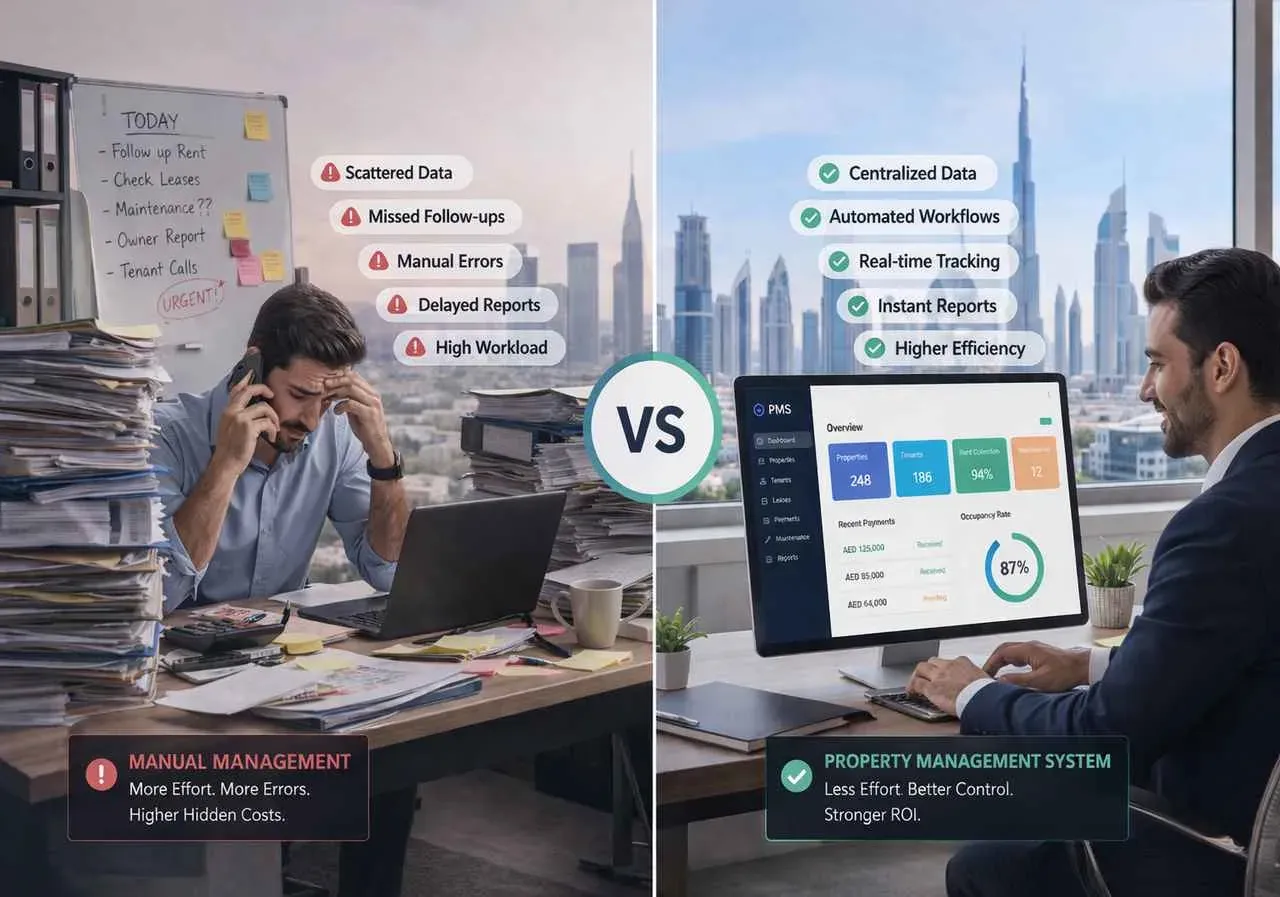
Manual vs Property Management System: Cost, ROI & Efficiency Explained
Manual vs Property Management System: Cost, ROI & Efficiency Explained
“This guide compares manual processes and system-based approaches to help property businesses understand when a transition becomes necessary.”
Most property businesses do not switch to software because they suddenly become interested in technology. They switch when the usual way of working starts getting heavier than it should. A few spreadsheets become too many, tenant follow-ups start slipping, and renewals need checking twice. Simultaneously, reporting takes longer than expected, and small mistakes begin showing up in places that affect money, time, and trust.
That is the point where the conversation changes.
Manual property management still exists across the UAE, and in very small setups, it can seem workable for a while. But once the number of units increases, or the business starts handling more tenants, more maintenance coordination, more contracts, and more reporting, the cracks become harder to ignore. So, what looked inexpensive at first begins turning into a slower and more expensive way to operate.
That is why more businesses are now comparing manual processes with Property Management Solution more seriously. This is no longer just about convenience. It is about cost control, cleaner operations, better visibility, and if the business can keep growing without becoming harder to manage.
Today, we will look at what manual management really involves, where the hidden costs usually stay, how software changes day-to-day work, a manual vs. system-based management comparison, and how to think about efficiency in a UAE property context.
What is manual property management?
Manual property management is precisely what many teams have been doing for years. They store tenant details in spreadsheets. Lease dates are tracked through calendars or reminders, and payment records sit in files, emails, chat messages, or accounting entries that are not always connected to each other. Simultaneously, maintenance updates are followed up by phone calls, WhatsApp messages, or handwritten notes passed around internally.
Nothing about this sounds unusual. In fact, that is why it often continues for so long.
The problem is not that manual management is impossible. The problem is that it depends too much on people remembering things, checking things, and updating things at the right time every single day in a property business, which creates pressure very quickly.
That is what manual management usually looks like in real life. It is just tiring, repetitive, and full of small gaps that slowly turn into operational problems.
Time-consuming tasks
Manual property work creates a lot of repeated activity that does not really move the business forward. Staff keep checking due dates, updating sheets, tracing old messages, reconciling amounts, and preparing reports from scratch. Even when each task looks small on its own, the total workload becomes heavy.
Human errors and missed payments
This is where manual work starts costing more than people expect. A wrong number in a spreadsheet, a missed rent reminder, a duplicate entry, or a delayed payment update may seem minor in isolation, but repeated across dozens or hundreds of tenants, those mistakes become expensive.
Compliance and recordkeeping pressure
UAE property operations also involve documentation and process discipline. When records are not connected to each other, it becomes much harder to maintain consistency. That is especially true when the business is dealing with lease documentation, tenant histories, financial records, and reporting expectations that need to be accessible and clear.
Why UAE businesses are moving away from manual systems
There is a reason this shift keeps happening. Property businesses are not replacing manual work because software sounds impressive in a meeting. They are replacing it because manual systems stop feeling manageable after a certain point.
Once a portfolio grows, even modestly, the volume of routine work increases faster than expected. It is not just more tenants. It is more contracts, more renewals, more reminders, more support requests, more financial checking, and more pressure from owners or management for faster updates.
That is where the benefits of digital property management start making immediate sense.
Businesses exploring this shift often evaluate a real estate property management software UAE that can centralize operations, improve tracking, and reduce manual workload across growing portfolios.
A proper PMS does not just digitize the same mess. It brings structure to work that is usually spread across too many places.
Here is what businesses usually gain first:
● Routine tasks become easier to automate.
● Tenant and lease records stay in one place.
● Payment visibility improves.
● Maintenance follow-up becomes easier to track.
● Reporting becomes faster and less dependent on one employee.
● Multi-property operations become easier to control.
● Teams can work with more confidence because the system holds the flow together.
This is why the phrase Manual vs Software Property comparison is really about more than tools. It is a question of if the business wants to keep relying on scattered admin work or move toward a system that can carry the operational load more cleanly.
When Should You Move from Manual to a Property Management System?
The shift usually happens when daily operations start taking more effort than they should. If your team spends too much time tracking leases, checking payments, and preparing reports, it’s a clear sign of inefficiency. Scattered data, frequent errors, missed follow-ups, and slow reporting further indicate that manual processes are no longer reliable. It becomes more evident as your portfolio grows and managing multiple properties feels difficult. At this stage, moving to a structured system is less about convenience and more about maintaining control, accuracy, and sustainable growth.
Once these signs become consistent, businesses usually start exploring more structured solutions
BCost comparison: manual property management vs. software solutions
A lot of businesses still assume manual management is cheaper simply because there is no monthly software bill attached to it. That sounds logical until the hidden costs are looked at honestly.
Manual systems cost money in quieter ways. They cost through staff time, correction work, missed follow-ups, delayed decision-making, and weak visibility when management needs accurate answers quickly. And they often cost through additional headcount that becomes necessary only because work is too fragmented.
Software, on the other hand, usually comes with a visible price. That makes it easier to question. But visible cost and actual cost are not the same thing.
Cost Comparison Table:
| Aspect | Manual Management | Software Management |
| Staff and labour cost | Higher because more admin hours are needed | Lower per property due to automation |
| Errors and revenue leakage | More likely | Significantly reduced |
| Reporting | Slow and manual | Faster and structured |
| Operational visibility | Limited | Clear and instant |
| Compliance handling | More dependent on manual checking | More organized and trackable |
| 1-year ROI | Usually weak | Usually stronger |
| Growth | Gets messy as the portfolio grows | Easier to scale |
Imagine a property business managing 150 to 200 units.
In a manual setup, the team may be spending a large amount every month on work that includes:
● Lease tracking
● Tenant reminders
● Payment checking
● Maintenance coordination
● Reporting preparation
● Spreadsheet updates
● Follow-up calls and message chasing
The payroll cost attached to those hours may already be substantial. Then there is the extra cost of inefficiency, where experienced staff spend time doing admin-heavy tasks instead of managing performance or tenant relationships properly.
By contrast, the property management digital system cost that businesses pay usually sits in a more defined range, including subscription, setup, user access, support, and sometimes customization. That cost is real, but at least it is direct and measurable.
Manual costs often look smaller only because they are hidden inside salaries, delays, and operational drag.
Where the hidden cost of manual work shows up
This is usually the part businesses notice too late. Manual property management does not fail all at once. It leaks value gradually.
The hidden costs often show up in the following ways:
Extra staff dependency
When systems are weak, operations depend heavily on specific people knowing where everything is. If one person is absent, leaves the company, or simply misses something, work will slow down quickly.
Delayed renewals and payment follow-up
Revenue timing matters. When reminders, due dates, and follow-ups are handled manually, the business becomes slower in acting on things that directly affect cash flow.
Reporting delays
When the management asks a simple question, and it takes hours or days to answer, that is not a reporting issue. That is a systems issue.
Maintenance communication gaps
This is one of the most common areas where manual work becomes messy. Requests come in through calls, chats, emails, or verbal conversations. Which means updates are scattered, and accountability is blurry.
How Manual vs Software Property Management Impacts ROI in UAE
The ROI of PMS in businesses is usually not based on one dramatic number. It comes from multiple improvements working together. That matters because many buyers expect ROI to show up only as direct cost reduction. In reality, the return is often broader than that.
1. Lower operational workload
The first gain is usually time. Tasks like reminders, renewal tracking, status checks, record access, and reporting become faster.
2. Fewer avoidable mistakes
Software does not make a business perfect, but it usually reduces missed tasks, duplicate entries, overlooked due dates, and poor internal visibility. That reduces the cost of correction and rework.
3. Faster decisions
When information is available quickly, management can act earlier. That affects collections, renewals, occupancy planning, and maintenance response.
Explore how a complete property management system works in real operations
Efficiency Gains Using Automated Property Management vs Manual Methods
Efficiency is one of those words people use too casually. In property operations, it means something very simple - How much work does it take to keep the portfolio under control?
Task automation and workflow improvement: When the system helps with reminders, due dates, tracking, approvals, and record access, your teams stop repeating the same small manual actions every day. That reduces admin fatigue and improves consistency.
Tenant communication and maintenance tracking: Software brings order to interactions that normally get scattered. A tenant issue can be logged, assigned, tracked, and closed in a more visible way. That improves service quality because the business is now less reliant on memory and individual follow-up.
Instant reporting and dashboards: This is one of the clearest differences between manual work and software-led management.
Manual reporting is reactive. Someone asks for data, then the team starts building it.
But software reporting is more immediate. The information is already organized, which means management gets answers faster and with less struggle.What to consider before choosing a property management system
Not every platform fits the UAE market equally well, and that matters more than many businesses realize. A software demo may look polished, but the real question is if the system fits the way local property operations actually work. Must-have features Look for: ● Multi-property management ● Lease and renewal tracking ● Tenant database management ● Payment visibility ● Maintenance workflow handling ● Reporting dashboards ● Accounting integration ● Role-based access ● Mobile or remote access If the software cannot handle the daily realities of lease-heavy and tenant-heavy operations, the design quality will not save it. Local support and training This part is often underestimated. Good support makes adoption easier, and local understanding matters. Teams need training that fits their actual workflow, not generic system explanations. Pricing clarity and demos Do not judge only by the monthly price. Ask what is included, what the setup looks like, if the support is ongoing, how training works, and what happens when the portfolio grows. If you want to understand how these improvements work in practice, exploring a property management software UAE solution can give better clarity on features, automation, and long-term efficiency. 1. What is property management software? Property management software is one system that keeps tenant details, leases, rent tracking, maintenance work, and reports together. Instead of checking different files, sheets, or messages, the team can handle everything from one place. 2. What are the advantages of software over manual property management in UAE Software offers clear advantages over manual property management in the UAE. It centralizes tenant and lease data, automates tasks, reduces errors, speeds up reporting, improves operational visibility, and allows businesses to manage multiple properties efficiently, making daily operations faster, accurate, and scalable. 3. What is the cost of PMS? There is no one fixed cost of property management systems. The cost usually depends on the number of properties being managed, the number of people who need access, and the features that are required. 4. What makes manual management expensive in the UAE? The real expense comes from lost time, repeated follow-ups, missed updates, reporting delays, correction work, and the extra staff effort needed to keep everything moving properly. 5. What ROI can a business expect from a property management system? The ROI of PMS usually shows up through saved time, fewer avoidable mistakes, faster reporting, better tracking, and less dependence on manual admin work. 6. Can software help with multi-property management? Yes, and that is one of the main reasons businesses move to it. Manually managing multiple buildings, units, tenants, and payment cycles quickly gets difficult. Software makes that structure much easier to control. 7. Does software help with maintenance tracking? Yes. It helps teams record complaints, assign jobs, follow progress, and close issues properly. Without a system, maintenance often ends up being tracked through calls, chat messages, or scattered notes, which is where things get missed. 8. Is property management digital system only for large companies? No, not at all. Smaller property businesses often feel the benefit early because they need to stay organized without hiring more people every time operations start getting busier. 9. What features matter most in a UAE setup? Usually, the basics matter first - lease tracking, tenant records, payment follow-up, maintenance handling, reporting, accounting connection, compliance, and support for managing multiple properties without switching between different tools all day. 10. How long does implementation take? That depends on the amount of data that needs to be cleaned, the size of the portfolio, and if the setup is simple or more customized. Some businesses move fast, while others take a phased route to avoid disruption.FAQs
 Our More Blogs